Joli Jensen suggests that “from the outside, academia looks like a supportive environment for writing. The reality is that the academic environment is hectic, demanding, distracting … [and] definitely not writing-friendly.” (Jensen 2017: xi)
In such an environment, how do we write? More importantly, how do we establish those good writing practices that will set us up for a productive, successful, long-term academic career?
For most organisations, the solution is traditional skills training: Individual sessions on areas like ‘writing for journals’ or ‘peer-reviewing articles’, augmented perhaps by some self-service online material. Perhaps a mentor who can give advice. Perhaps a lending library of supportive texts.
There’s nothing wrong with that approach. I deliver training like that too.
But try running a longer-term evaluation, and you’ll find that it’s often not as effective as you’d like. With different people attending each session, each one treated like a discrete topic, and gaps between them, there’s little continuity. besides, I always wonder about what happens in between. Yes, people can read, try things out, set up support groups and so on… but do they? My feeling is that they probably don’t… or they would, but they can’t find the time…
Are we happy that success in writing, like many other successes in academia, comes easiest to those privileged few who probably didn’t need much support in the first place?
But what if you could weave together that training with a continuity of materials – papers to read, questions to think about, peers to support and challenge you, coaches to consult with. And what if you could do this over a good, long, sustained period of time… Might that result not just in the acquisition of head knowledge, but foster real change?
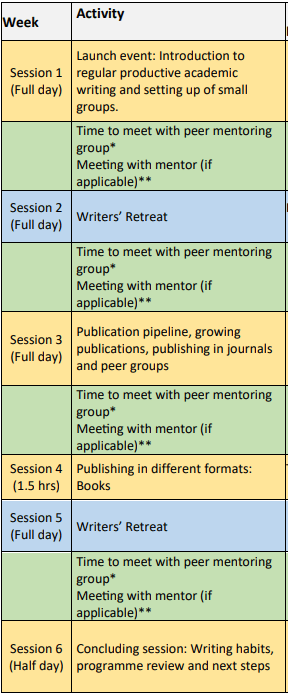
One way to do that might be a programme approach, like in the example on the right.
This is a real programme, that I’m delivering at the moment. It combines traditional training sessions with two writers’ retreats (one in person, and one hybrid), additional content, and (crucially) time… to give those involved the tools, the opportunity and the support to engage in really embedding writing into their everyday.
It also includes the coordination of small peer mentoring groups (which are unstructured, but could be run as an Action Learning Set) and a sustained weekly communication of follow-up material to main sessions, small-group guidance and questions, selected chapters to books, links to blogs, and so on.
Each programme is different, and can be tailored around the needs of the community involved. I’ve run a 12-month one, with a looser structure and more attention to community interaction around monthly writers’ retreats. I’ve run one that focused almost entirely on individual 1:1 coaching support. And I’ve run a one-month ‘WriteFest’ one, for PhD students, that hung on weekly online discussion groups.
 The Garage of Books