I’ve been writing… and reading. My reading is often tailored to the time of day that it happens. Daytime is for complicated reading. Nighttime is for reading that doesn’t require too much attention before I go to sleep.
My nighttime reading at the moment is Lee Child’s Jack Reacher series. I’m interspersing that with Ian Fleming and Colin Dexter. (Hmm. I’ve just noticed that’s a very specific type of male vision of life I’m feeding myself there *raises eyebrow at self*).
I always start at the beginning of series, so I started the Jack Reacher series with the first book – “Killing floor” – Here’s the first page reproduced here for your enjoyment.
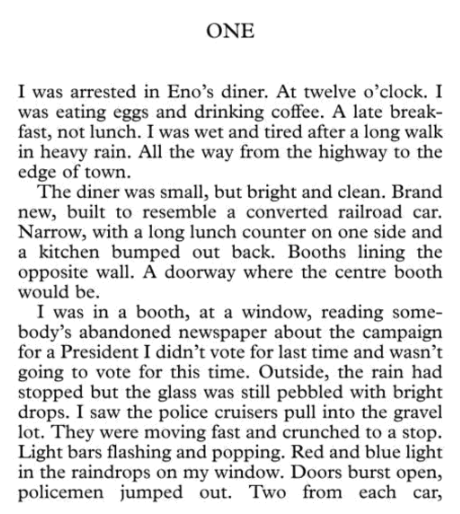
I was arrested in Eno’s diner. At twelve o’clock. I was eating eggs and drinking coffee. A late breakfast, not lunch. I was wet and tired after a long walk in heavy rain. All the way from the highway to the edge of town. The diner was small, but bright and clean. Brand new, built to resemble a converted railroad car. Narrow, with a long lunch counter on one side and a kitchen bumped out back. Booths lining the opposite wall. A doorway where the centre booth would be. I was in a book, at a window, reading somebody’s abandoned newspaper about the campaign for a President I didn’t vote for last time and wasn’t going to vote for this time. Outside the rain had stopped but the glass was still pebbled with bright drops. I saw the police cruisers pull into the gravel lot. They were moving fast and crunched to a stop. Light bars flashing and popping. Red and blue light in the raindrops on my window. Doors burst open, policemen jumped out. Two from each car,
What struck me as I read was how short the initial sentences are: 6 words, 3 words, 7 words, 5 words, 12 words. 11 words, 8 words…
Reading it is like being punched. Repeatedly. In the face.
See what I did there?
I’m not sure I like it. But the effect is interesting. It carries you in, quickly, and doesn’t require too much attention. It also seems to create a kind of ‘stutter’ in the narrative which is then relieved when you get to the first sentence of the third paragraph, and finally get a good run at a whole 33 words.
The reason I bring this up is that I have often had a tendency to go the opposite way and write sentences that are long–sometimes to the extent that they take up an entire paragraph–and contain so many sub-clauses and asides that they are often difficult to read, or at least parse into meaningful sections which is an issue that particularly shows up when you try and break them down into smaller sentences and find that you can’t because you can’t work out where to put the stops.
(91 words – wahay!)
I’ve never really paid too much attention to the length of sentences and what effect that has on the narrative. But others clearly have. Here’s a quote from https://languagetool.org/insights/post/sentence-length/

And it’s not just about style. It’s about understanding.
Here, even the British Government weighs in. On a .gov.uk page entitled “Sentence Length: why 25 words is our limit”, the government tell us why they aim keep every sentence on their website below 25 words.
Writing guru Ann Wylie describes research [link broken (FFS)] showing that when average sentence length is 14 words, readers understand more than 90% of what they’re reading. At 43 words, comprehension drops to less than 10%.
https://insidegovuk.blog.gov.uk/2014/08/04/sentence-length-why-25-words-is-our-limit/
Studies also show that sentences of 11 words are considered easy to read, while those of 21 words are fairly difficult. At 25 words, sentences become difficult, and 29 words or longer, very difficult.
I don’t usually believe anything that my government tells me. But since they’re channeling others, and my gut (and Lee Childs confirm) I might just start paying attention.
The question, of course, is how to bring this to academic writing. That’s something I’m going to puzzle over, and get back to you on.
 The Garage of Books